
Regular engine maintenance helps keep your boat reliable, protects its value, and reduces the risk of an unexpected breakdown during the boating season.
So, how often should a boat engine be serviced?
For many recreational boats, engine service is recommended once a year or every 100 operating hours, whichever comes first. New engines usually require an important initial 20-hour service after the break-in period.
However, maintenance schedules vary by engine manufacturer, model, age and propulsion type. Always consult your owner’s manual for the specific requirements of your engine.
What Is a 20-Hour Boat Engine Service?
Many new marine engines require an initial service after approximately the first 20 hours of operation. This is often referred to as the 20-hour service, break-in service or first service.
During the first several hours of use, new engine components begin to settle and wear together. The initial service gives a marine technician an opportunity to inspect the engine after the break-in period and identify any developing issues.
Depending on the manufacturer and engine model, a 20-hour service may include:
- Changing the engine oil and oil filter
- Inspecting or replacing the gearcase lubricant
- Checking fuel-system components
- Inspecting belts, hoses and connections
- Checking fluid levels
- Inspecting the propeller and propeller shaft
- Lubricating specified fittings
- Checking for leaks, loose fasteners or unusual wear
- Reviewing the engine for fault codes or warning conditions
Not every engine follows the same 20-hour schedule, so owners should follow the maintenance requirements listed in their manufacturer’s manual and consult their marine technician for what to do.
Skipping an initial service could allow a small problem to go unnoticed and may affect warranty documentation. Schedule your boat service today.
Does a Boat Engine Need Service Every Year?
Yes, always yes. Recreational boat engines should receive professional service at least once each year, even when the boat has not accumulated 100 operating hours.
Marine engines are exposed to moisture, corrosion, changing temperatures and periods of inactivity. These conditions can affect an engine even when the boat is only used occasionally.
Annual boat engine service commonly includes:
- Engine oil and filter replacement
- Fuel-filter inspection or replacement
- Gearcase or lower-unit lubricant replacement
- Cooling-system inspection
- Belt and hose inspection
- Battery and electrical checks
- Fluid-level checks
- Spark-plug inspection when applicable
- Inspection for leaks, corrosion and unusual wear
Annual boat maintenance can often be completed during fall winterization or spring commissioning.
What Is a 100-Hour Boat Engine Service?
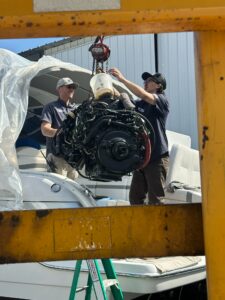
The 100-hour service is one of the most common marine-engine maintenance milestones. For many boat owners, it occurs at approximately the same time as annual service.
Boaters who use their vessels frequently may reach 100 hours before the end of the season. In that case, service should be scheduled based on engine hours rather than waiting until the following year.
A typical 100-hour service may include:
- Changing the engine oil and oil filter
- Replacing fuel filters
- Changing lower-unit or gearcase lubricant
- Inspecting spark plugs
- Inspecting the cooling system
- Checking the propeller and propeller shaft
- Lubricating recommended fittings
- Inspecting belts and hoses
- Testing the battery and electrical system
Some engines also have more extensive maintenance requirements at 300 hours, 500 hours or other manufacturer-designated intervals.
How Often Should Boat Engine Oil and Filters Be Changed?
For many four-stroke marine engines, the oil and oil filter should be changed every 100 operating hours or once per year, whichever comes first.
Engine oil collects contaminants and gradually loses its ability to properly lubricate and protect internal components. Even a lightly used boat may need an annual oil change because moisture and combustion byproducts can accumulate over time.
Fuel filters are also commonly inspected or replaced during annual or 100-hour service. A clogged or contaminated fuel filter can contribute to:
- Difficulty starting
- Rough idling
- Engine hesitation
- Stalling
- Reduced power
- Poor fuel efficiency
Always use oil, filters and replacement parts that meet the engine manufacturer’s specifications.
How Often Should a Boat Impeller Be Replaced?
The water-pump impeller helps circulate cooling water through the engine. Because it is generally made from flexible rubber or a similar material, it can wear, crack or deteriorate over time.
Impeller replacement intervals vary by manufacturer, engine and operating conditions. Some manufacturers recommend replacement at a specific engine-hour milestone, while others call for regular inspection.
Operating in sandy, silty or debris-filled water may cause an impeller to wear more quickly.
Possible signs of an impeller or cooling-system problem include:
- A weak or inconsistent cooling-water stream
- An overheating alarm
- Higher-than-normal engine temperature
- Steam or an unusual smell
- Reduced engine performance
An overheating engine should be shut down as soon as it is safe to do so. Continuing to operate it could result in significant engine damage.
Inspect Belts, Hoses and Fluids
Routine maintenance should include more than oil and filter changes.
Engine belts should be inspected for cracking, fraying, glazing, looseness or unusual wear. Hoses should be checked for cracking, softness, bulging, leaks and damaged connections.
Depending on the boat and propulsion system, a technician may also inspect:
- Engine coolant
- Power-steering fluid
- Hydraulic fluid
- Trim-and-tilt fluid
- Transmission fluid
- Gearcase lubricant
- Lower-unit oil
Low, discolored or contaminated fluid may indicate water intrusion, a leak or another developing mechanical issue.
Signs Your Boat Engine Service Is Overdue
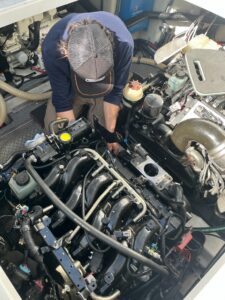
Do not wait for the engine to stop running before scheduling service. Changes in starting, performance or sound may indicate that maintenance or repairs are needed.
Common warning signs include:
- Difficulty starting
- Rough or inconsistent idling
- Stalling
- Reduced speed or acceleration
- Loss of power under load
- Increased fuel consumption
- Excessive smoke
- Unusual vibration
- Knocking, grinding or squealing sounds
- Overheating
- Warning alarms or dashboard lights
- Visible oil, fuel or coolant leaks
- A weak cooling-water stream
These symptoms can have several possible causes. Professional diagnostics can identify the underlying issue before additional damage occurs.
Does a Lightly Used Boat Still Need Service?
Yes. Low engine hours do not eliminate the need for annual maintenance.
A boat that sits unused for extended periods can experience:
- Battery discharge
- Fuel deterioration
- Moisture accumulation
- Corrosion
- Aging seals and hoses
- Electrical-connection problems
- Impeller deterioration
Both calendar time and operating hours should be considered when creating a maintenance schedule.
Keep Track of Your Engine Service
Maintain a record of every service appointment, including the date, engine hours and work performed.
Accurate records make it easier to anticipate future maintenance, support warranty documentation and demonstrate proper care when it is time to sell or trade the boat.
Record the engine hours at the beginning and end of every boating season. This will help you determine whether your next service is due according to time, operating hours or both.
Schedule Boat Engine Service in Chester, CT
Staying ahead of routine maintenance can help prevent avoidable repairs and keep your boat ready for the season.
Whether your engine is approaching its initial 20-hour service, due for annual maintenance or nearing the 100-hour milestone, the team at Chester Boat Basin can help evaluate its service needs.
For trusted, fast, and professional boat engine service in Chester, CT, contact Chester Boat Basin by calling us at 860-526-5147 or emailing us at info@chesterboatbasin.com to schedule routine maintenance and spend more time enjoying the Connecticut River.